






Planning a vietnam trip? Let us help.
Get personalized travel plan based on your interest, budget and preferred travel dates
Discover how a Vietnam DMC manages complex multi-city itineraries, from route planning and private transportation to hotels, local guides, customized experiences, and on-ground travel support.
TABLE OF CONTENTS
1
A Multi-City Trip Is About More Than Counting Destinations
2
How the Route Is Put Together
3
Flights Are Only One Part of the Journey
4
Hotels Should Fit the Journey Too
5
The Guides Should Not Feel Like Separate Pieces
6
The Best Itineraries Leave Some Room to Breathe
7
What Happens When Plans Change?
8
How Can a Vietnam DMC Handle Complex Multi-City Itineraries?
9
When Is a DMC Particularly Useful?
10
Can One Specialist Coordinate Vietnam, Cambodia and Laos?
11
Is a Vietnam DMC Useful for a Multi-City Trip?
12
What Should You Ask Before Choosing a DMC?
13
What Makes a Multi-City Itinerary Feel Well Planned?
14
Why Local Coordination Matters When Choosing a Vietnam Travel Company
15
Conclusion
16
FAQs
1. How does a Vietnam DMC manage a multi-city itinerary?
2. Can a Vietnam DMC arrange private transportation between destinations?
3. Can a Vietnam DMC customize a multi-city Vietnam itinerary?
4. Is a Vietnam DMC useful for travelers from the United States?
5. Can a Vietnam DMC arrange luxury multi-city travel?
6. Can one travel company coordinate Vietnam, Cambodia, and Laos?
7. What should I ask a Vietnam DMC before booking?
8. What is the difference between a Vietnam DMC and a Vietnam Tour Operator?
9. Do I need a DMC for every Vietnam trip?
10. Can a Vietnam travel company help reduce unnecessary travel time?
A Vietnam trip can look simple when you are looking at a map.
Hanoi is in the north. Hoi An is in the center. Ho Chi Minh City is farther south. Add Ha Long Bay, the Mekong Delta, or a few days in Cambodia, and suddenly the vacation involves flights, cars, hotels, guides, boats, and several different schedules.
For a traveler in the United States, putting all of that together from home can take quite a bit of work.
The challenge is not finding a hotel or booking a flight. Those things are easy enough to do individually. The harder part is making sure everything works together once the trip starts.
That is one reason travelers work with a Vietnam DMC.
A Destination Management Company works with local hotels, drivers, guides, cruise operators, activity providers, and other suppliers. Instead of treating every reservation as a separate task, a Vietnam Destination Management Company can look at the trip from beginning to end and coordinate the different pieces around one itinerary.
A Multi-City Trip Is About More Than Counting Destinations
It is tempting to build a Vietnam itinerary by making a list of places you want to see.
Hanoi.
Ha Long Bay.
Hoi An.
Hue.
Ho Chi Minh City.
Mekong Delta.
The list looks exciting.
The problem starts when you try to fit all of it into 10 or 12 days.
Every move takes time. There is packing, checking out, getting to the airport, waiting for a flight, collecting luggage, reaching the next hotel and getting settled again.
(3).jpg)
This is particularly important for U.S. travelers because a significant part of the vacation has already been spent getting to Vietnam.
A local planner can look at the itinerary differently. Instead of asking how many destinations can be squeezed into the available days, the question becomes whether the route will actually be enjoyable.
Sometimes the answer is to remove a destination. Sometimes it means staying an extra night somewhere. In another case, a private road transfer may work better than another flight.
Those decisions are small on paper, but they can change the feel of the entire trip.
How the Route Is Put Together
A Vietnam Destination Management Company usually starts by understanding what the traveler wants from the trip.
A couple interested in food and local culture will not necessarily need the same itinerary as a family traveling with children. Someone visiting Vietnam for photography may want more time in certain landscapes, while another traveler may be much more interested in history and architecture.
The route can then be built around those priorities.
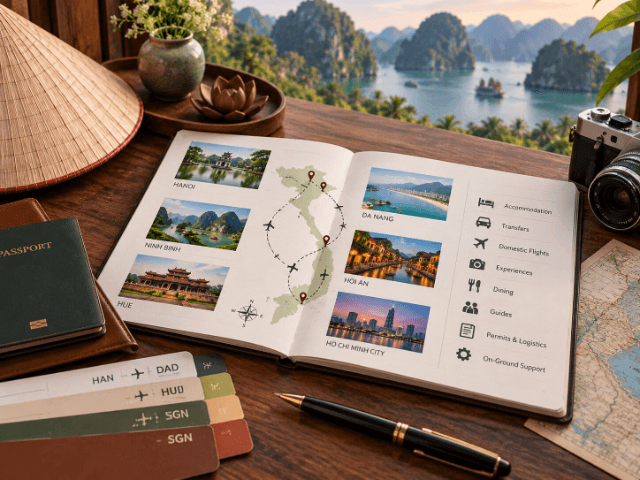
For example, Hanoi, Ninh Binh and Ha Long Bay can form one part of a northern itinerary. Hoi An and Hue may work well together in central Vietnam, while Ho Chi Minh City and the Mekong Delta can be considered as part of the southern section.
That does not mean every traveler should follow the same pattern.
The point is to understand how the destinations connect before making the bookings.
This is where local knowledge becomes useful. A map can show distance. Someone working with these routes regularly can also understand the practical travel time, traffic, transfer arrangements and the amount of time travelers generally need at each stop.
For Vietnam Travel Agents planning journeys for their clients, this local coordination can also make it easier to build an itinerary around realistic travel times rather than simply adding destinations to a map.
.png)
Flights Are Only One Part of the Journey
Domestic flights are useful for covering longer distances in Vietnam, but booking the flight is only the beginning.
Suppose a traveler flies from Hanoi to Da Nang.
Someone still needs to arrange the airport pickup. The driver needs the correct arrival information. The hotel needs to know when the guest is expected. If there is a private tour later that afternoon, the timing needs to allow for the transfer and check-in.
The same process happens again when the traveler moves south.
A vietnam travel company handling the itinerary can coordinate those separate pieces instead of leaving the traveler to manage each one.
Private vehicles can also make sense for shorter routes.
If two destinations are close enough to reach by road, a private transfer may give travelers more flexibility than another flight. In some cases, the journey itself can include a stop at a place that the traveler would otherwise miss.
There is no single transportation method that works for every itinerary. Good planning is about choosing the option that makes sense for that particular route.
Hotels Should Fit the Journey Too
Choosing accommodation for a multi-city trip is not simply a matter of selecting the highest-rated property.
Location matters.
A hotel that works well for exploring central Hanoi may not be the right choice for someone who wants a quiet final few days beside the coast. A property in Hoi An may be selected for access to the old town, while accommodation in another destination might be chosen primarily for relaxation.
This is another area where local coordination can help.
A DMC can consider the hotel together with the activities and transportation planned around it. That reduces the chance of creating an itinerary where travelers spend unnecessary time getting from their hotel to the places they actually want to visit.
.jpg)
It also makes it easier to coordinate different properties when the trip involves several destinations.
When comparing a vietnam tour agency or local travel specialist, travelers can therefore look beyond hotel selection and consider how accommodation fits into the wider itinerary.
The Guides Should Not Feel Like Separate Pieces
A multi-city journey may involve several local guides.
That is perfectly normal.
The guide in Hanoi may have a different area of expertise from the person accompanying travelers in Hoi An or Ho Chi Minh City. What matters is that the overall experience remains connected.
Suppose travelers mention during the planning stage that they are particularly interested in Vietnamese food.
That preference can influence the itinerary beyond one cooking class. It might affect which markets they visit, what neighborhoods they explore, or the type of local dining experience arranged in another destination.
The same applies to history, photography, architecture, wellness or outdoor activities.
This is one of the advantages of customized planning. The itinerary can reflect the traveler rather than simply following a fixed schedule.
The Best Itineraries Leave Some Room to Breathe
This is probably the easiest part of travel planning to overlook.
A full itinerary can look impressive when it is written down.
In reality, travelers need time to have breakfast without rushing, enjoy a hotel, stop for coffee, wander through a neighborhood or simply recover after a long travel day.
For a 12-day Vietnam vacation, adding six destinations may sound ambitious. It may also mean spending a surprising amount of time in transit.
A Vietnam Tour Operator or DMC with experience in customized travel can help identify where the itinerary needs more breathing room.
This is particularly relevant to premium travel.
6(1).png)
Luxury Travel Vietnam is not necessarily about putting the most expensive hotel into every city. For many travelers, having a private transfer waiting at the airport, avoiding unnecessary hotel changes, having a knowledgeable guide and knowing that someone can help if plans change are all part of the experience.
For travelers researching the best tour company for Vietnam, it can therefore be useful to look at how a company handles the details between destinations, rather than focusing only on the number of hotels, tours or destinations it lists.
What Happens When Plans Change?
Even a carefully planned itinerary can run into an unexpected problem.
A flight may be delayed. Heavy traffic may affect a transfer. Rain may interfere with an outdoor activity. A traveler may simply decide that they do not want to continue with something that was planned months earlier.
When every booking has been made separately, fixing the problem becomes the traveler's responsibility.
With a local DMC, there is someone who can communicate with the relevant suppliers.
The driver can be contacted. The hotel can be updated. A guide can be rescheduled. An activity may be moved to another day if the provider allows it.
It does not mean every problem can be avoided.
It means travelers are not necessarily left trying to solve a local problem from thousands of miles away.
This type of on-the-ground support is one reason travelers may choose a local vietnam tour company when planning a more complicated private journey.
How Can a Vietnam DMC Handle Complex Multi-City Itineraries?
A Vietnam DMC handles a complex multi-city itinerary by coordinating the local services that connect each destination, including hotels, private transfers, domestic transportation, guides, cruises and activities.
.jpg)
The DMC can build the route around the traveler's available time and interests, then coordinate the individual services so that they work together. If a flight or transfer changes, the local team can communicate with the relevant suppliers and make adjustments where possible.
For international travelers, the main benefit is having one local point of coordination rather than managing multiple destination services independently.
When Is a DMC Particularly Useful?
A DMC is not necessary for every Vietnam vacation.
If someone is spending a week in one city and arranging their own day trips, independent planning may be perfectly practical.
The situation is different when the trip includes:
- Several Vietnamese destinations
- Private transportation
- Multiple domestic flights
- Different local guides
- Customized activities
- Luxury accommodation
- Family or private group arrangements
- Vietnam combined with Cambodia or Laos
The more of these elements that appear in an itinerary, the more coordination is involved.
That is where a local specialist can become useful.
For travelers comparing different vietnam tour agency options, it is worth asking whether the company actually manages these destination-side details or simply sells a pre-designed package.
Can One Specialist Coordinate Vietnam, Cambodia and Laos?
Yes, provided the company has the appropriate regional network and operational experience.
A traveler planning Vietnam, Cambodia and Laos may otherwise find themselves working with separate companies in each country.
That can create unnecessary communication between different teams.
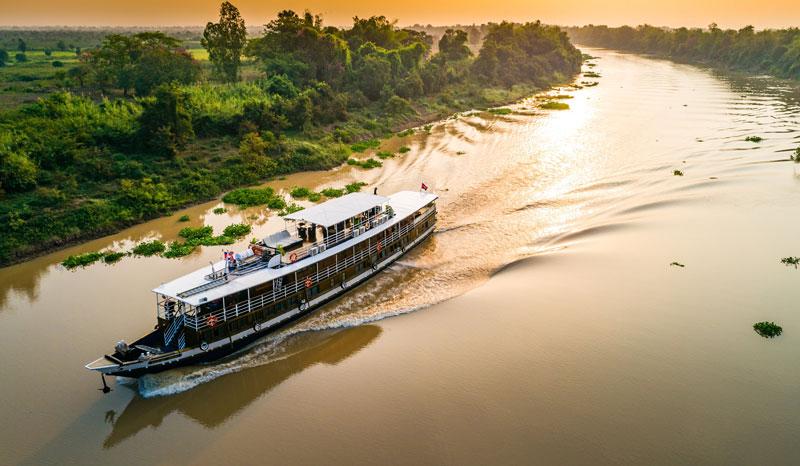
An Indochina Tour Operator can coordinate the journey as a connected itinerary, including accommodation, transportation, guides and activities across the different destinations.
For example, a U.S. traveler could spend several days in northern Vietnam, continue through central Vietnam, then travel to Siem Reap before adding a few days in Laos.
(1).jpg)
The exact route depends on the available vacation time.
What matters is that the transitions between countries are considered as carefully as the destinations themselves.
This can be particularly helpful for people planning trips to Vietnam and Cambodia, where the international and regional connections need to fit into the larger vacation schedule.
Is a Vietnam DMC Useful for a Multi-City Trip?
A Vietnam DMC can be useful when a trip involves multiple destinations, private services or complicated transportation arrangements. Its local team can coordinate accommodation, transfers, guides, activities and other destination services as part of one itinerary.
For a simple independent trip, a DMC may not be necessary. For a customized journey covering several regions of Vietnam, a DMC can reduce the amount of logistical planning the traveler has to handle personally.
The key is to choose a company based on its actual local capabilities, rather than simply whether it uses the term DMC, travel agency or tour operator.
What Should You Ask Before Choosing a DMC?
Before committing to a company, ask practical questions.
Who will be available after you arrive?
Who handles your airport transfer?
What happens if your domestic flight is delayed?
Can the itinerary be changed?
Are the guides locally based?
Can the company arrange private transportation?
Can it coordinate Vietnam with Cambodia or Laos?
How much of the itinerary can be built around your interests?
These questions will tell you considerably more than a polished website or a long list of destinations.
They can also help travelers distinguish between a company that provides genuine local support and one that primarily handles bookings.
.jpg)
What Makes a Multi-City Itinerary Feel Well Planned?
Interestingly, travelers may not notice most of the work when everything goes well.
They simply arrive at the airport and find their driver.
They reach the hotel without having to work out the transfer.
The guide arrives when expected.
The next morning's activity does not conflict with the flight schedule.
There is enough time to enjoy the destination.
That is what good coordination looks like.
It is not necessarily about adding more activities or making the itinerary longer. Often, it is about removing unnecessary complications before they become a problem.
For a U.S. traveler who has spent months looking forward to a Vietnam vacation, that can make a considerable difference.
Why Local Coordination Matters When Choosing a Vietnam Travel Company
There are many ways to arrange a Vietnam vacation. Travelers can book flights and hotels themselves, work with an overseas travel advisor, or contact a local specialist.
For a more complex itinerary, the important question is what happens behind the booking confirmation.
A local Vietnam travel company can have direct relationships with hotels, transportation providers, guides and activity operators in the destinations where the trip takes place. This can make communication easier when the itinerary needs to be adjusted.
For Vietnam Travel Agents, working with a destination-based partner can also provide access to local operational support that may be difficult to manage remotely.
The terminology can vary. A company may describe itself as a DMC, tour operator, travel agency or travel company. What matters is the actual service behind that description.
Conclusion
A multi-city Vietnam journey has a lot happening behind the scenes.
Flights, hotels, transfers, guides, cruises and activities all have to fit into the same calendar. Once Cambodia or Laos is added, the coordination becomes even more important.
A Vietnam DMC can take responsibility for many of those destination-side arrangements and keep the different parts of the trip connected.
The right approach is not to judge a company simply by whether it calls itself a DMC or a Vietnam Tour Operator. Look at its local team, experience, supplier relationships, communication and ability to customize the itinerary.
For travelers who want to see more of Vietnam without spending their vacation managing logistics, working with a local specialist such as Threeland Travel can provide a practical way to bring the different parts of a private journey together.
FAQs
1. How does a Vietnam DMC manage a multi-city itinerary?
A Vietnam DMC coordinates the different parts of the journey, including hotels, airport transfers, private transportation, local guides, and activities. Instead of treating each destination as a separate booking, the itinerary is planned as one connected trip.
2. Can a Vietnam DMC arrange private transportation between destinations?
Yes. A DMC can arrange private vehicles, airport transfers, and domestic flights depending on the route. The transportation can be planned around the traveler's schedule, preferred pace, and the amount of time available.
3. Can a Vietnam DMC customize a multi-city Vietnam itinerary?
Yes. A Vietnam Destination Management Company can build an itinerary around a traveler's interests, available vacation time, group size, and preferred travel style. Destinations, activities, hotels, and transportation can all be adjusted as part of the planning process.
4. Is a Vietnam DMC useful for travelers from the United States?
It can be particularly useful for U.S. travelers planning a longer or more complicated Vietnam trip. A local team can handle destination arrangements and provide on-ground assistance, which means travelers do not have to manage every issue remotely while they are in Vietnam.
5. Can a Vietnam DMC arrange luxury multi-city travel?
Yes. Luxury Travel Vietnam can include private transfers, premium accommodation, dedicated guides, and carefully selected local experiences. A luxury itinerary can also be designed with a slower pace so travelers have enough time to enjoy each destination.
6. Can one travel company coordinate Vietnam, Cambodia, and Laos?
Yes. An experienced Indochina Tour Operator can coordinate accommodation, transportation, guides, activities, and other arrangements across multiple countries. This can be useful for travelers planning trips to Vietnam and Cambodia or adding Laos to a longer Southeast Asia journey.
7. What should I ask a Vietnam DMC before booking?
Ask who will manage the trip after arrival, how private transportation and guides are arranged, whether the itinerary can be customized, and what happens if a flight or activity changes. It is also worth asking about the company's experience with multi-city travel and its ability to provide local support.
8. What is the difference between a Vietnam DMC and a Vietnam Tour Operator?
A Vietnam DMC generally focuses on destination-side operations and local coordination, while a Vietnam Tour Operator typically focuses on designing and operating complete travel programs. Some companies provide both services, so it is useful to look at their actual capabilities rather than relying only on the title.
9. Do I need a DMC for every Vietnam trip?
Not necessarily. Someone staying in one destination and arranging simple activities independently may not need extensive local coordination. A DMC becomes more relevant when a trip includes several destinations, private services, customized experiences, or multiple countries.
10. Can a Vietnam travel company help reduce unnecessary travel time?
Yes. A local Vietnam travel company can consider the order of destinations, transportation options, hotel locations, and activity schedules when building the itinerary. This can help avoid unnecessary backtracking and leave more time for actually enjoying the trip.
Customize This Itinerary
Let our local experts design the perfect itinerary for you. It’s free, personalized, and take less than 24 hours !
 No obligation100% personalizedBest Price Guarantee2M$ Liability Insurance
Jennifer Vu

Follow Us